[This article was first published on December 16, 2016 in Thotkata feminist blog]
Hana Shams Ahmed
IN 2015 filmmaker Aung Rakhine unveiled the first feature film made in the Chakma language about the community from the Chittagong Hill Tracts (CHT). The Bangladesh Film Censor Board (BFCD) refused clearance to the film, as a result of which the film could not be shown in public halls inside the country although it was shown at various overseas film festivals and won cr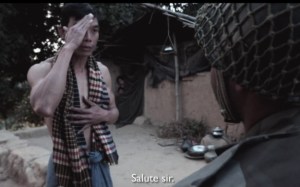 itical acclaim. The censor board claimed that it was only authorized to give clearance to films made in Bangla, the state language according to the national constitution. Apart from the technicality cited by the censor board, the Ministry of Information of the Government of Bangladesh also made a formal objection about the film’s content saying that the film had “…visuals and dialogue which were defamatory to the security forces and the Government of Bangladesh”, and which was “part of the propaganda against the military in the CHT”.[1] The film is about a poor Chakma villager Komol and how he develops an entrepreneurial niche in his village by ferrying people to and from the local market on his bicycle after losing his job in the city. The visual in question is about 30 seconds long within the one-hour-long film. Komol’s young son is seeing playing with some plastic toys on the courtyard when he suddenly gets up and runs to his mother and they both go inside the house to hide. Komol gets up and faces the (Bangladeshi) military officers who seem to be passing by their house and salutes them. It then shows the boots of the military officers crushing the toys on the courtyard on their way out. We do not see the faces of these individuals and later when I interviewed Aung he told me that he had deliberately left it open for interpretation for the public.
Such symbolic scenes of military violence have been depicted many times in many Bangladeshi films. However, those films have been accepted and many have received national acclaim because in these films the military perpetrators are Pakistani soldiers and the victims are Bengali. These depictions fit perfectly into the acceptable national narrative and in fact reinforce it. Rakhine’s film on the other hand disturbs this narrative tremendously. In 10 seconds Rakhine managed to stir up a part of Bangladesh’s history that the state has tried long and hard to keep out of the national narrative and media focus. Bangladesh’s state-constructed history is about the struggle for independence from Pakistan, about the heroism of the Bengalis, and the brutality faced by them. Bangladesh’s history has no room for talking about heroes and victims who are not Bengali. This erasure is not limited to the indigenous peoples only. In this narrative there is also a silence around Urdu-speaking victims of 1971. While many camp-based Urdu-speakers worked as collaborators with the Pakistani army, many were not. However, in the national narrative the whole community of Urdu-speakers have been relegated to the status of “collaborators” and “traitors”. On the same vein, many Bengalis were collaborators too but with their majoritarian privilege which did not lead to any such identity-based stereotyping. This majoritarian privilege can only be maintained if the faults of the few can be conflated to demonize a whole community of minoritized people, and a political and economic benefit can be gained from it.


 Posted by hanashams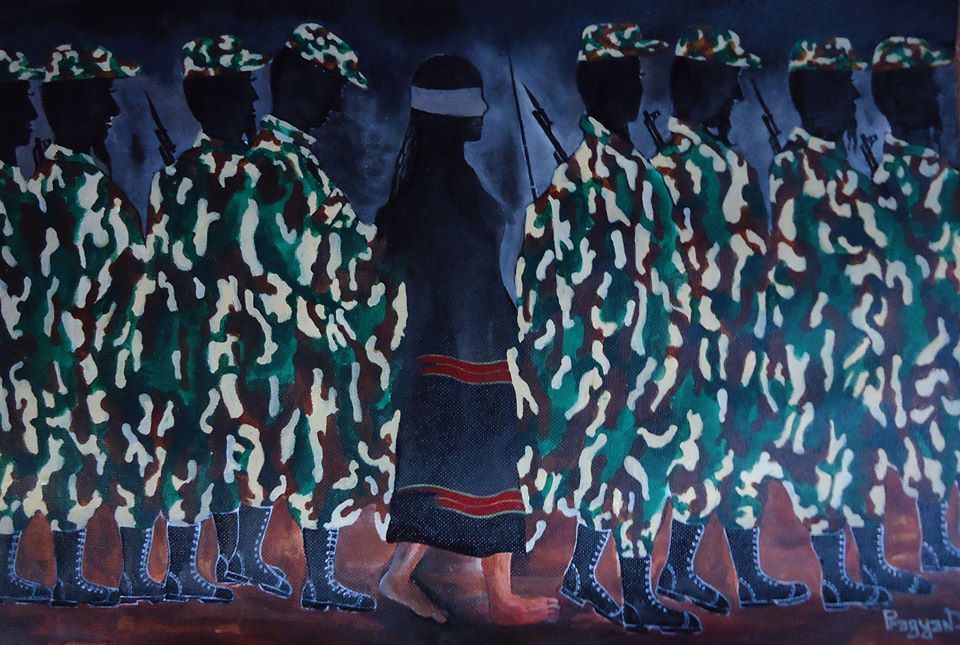
 Hana Shams Ahmed
You must be logged in to post a comment.